
Water scarcity is one of the biggest challenges facing agriculture across the Southern and Eastern Mediterranean (SEMED) region. With water resources under growing pressure, improving how every drop is used has become essential for safeguarding food security, rural livelihoods and agricultural growth.
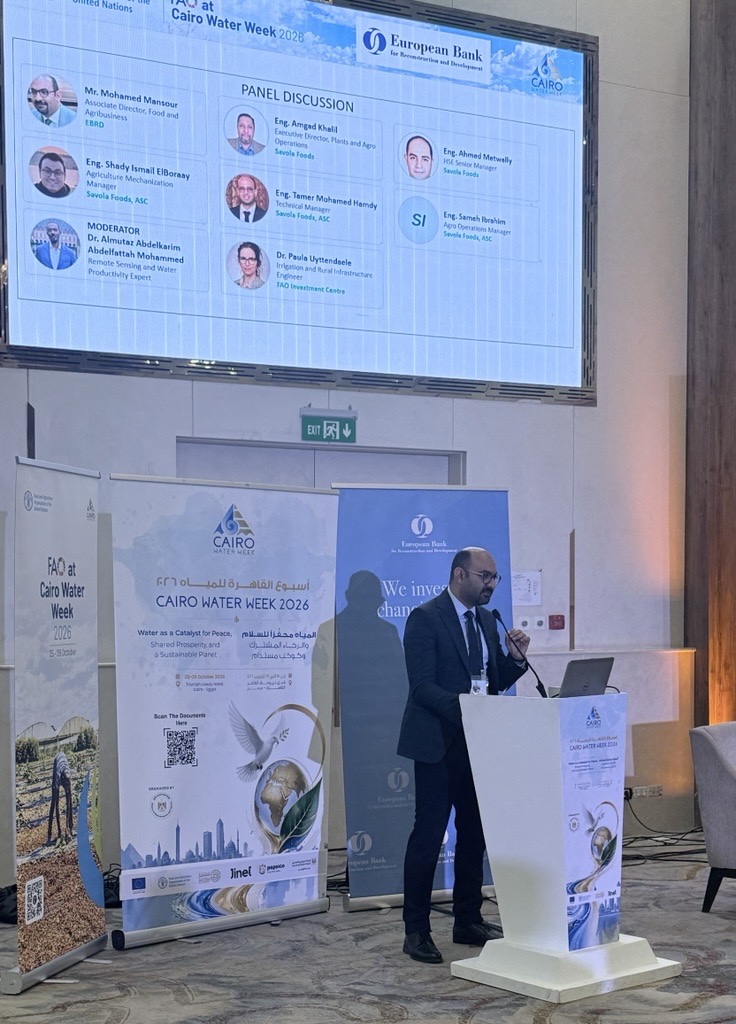
On 29 October 2026, the EBRD and FAO held a technical session at Cairo Water Week in Egypt to explore how satellite data and economic analysis can support better water management and investment decisions in agriculture. Drawing on joint work with FAO’s Land and Water Division under the EBRD–FAO Food Security Package, the session presented findings on economic water productivity across the SEMED region, examining how countries can generate greater agricultural value from increasingly scarce water resources.
The session was opened by Mr Walid Hakiki, Head of the Planning Sector at Egypt’s Ministry of Water Resources and Irrigation, and Executive Director of the Cairo Water Week Permanent Secretariat. He highlighted the importance and timeliness of combining satellite data with agricultural and economic analysis to improve water productivity, inform investment decisions and support more effective water resources planning and management.
The event was an opportunity for the EBRD and FAO experts to present their work under the Package, where they combined satellite technology, farm surveys and economic analysis to understand not only how much water crops consume, but also how much value that water generates. Using the FAO water productivity portal, WaPOR, the initiative examined agricultural water use across Egypt, Jordan, Morocco, Tunisia and the West Bank, providing insights that were previously difficult and costly to obtain.
The findings show that smarter water management can improve productivity without increasing water consumption. In some cases, adjusting irrigation schedules or timing water applications more precisely can boost yields and farm incomes. The analysis also identified opportunities for agribusinesses and policymakers to make more informed investment decisions and support farmers facing increasing climate pressures.
Beyond the technology itself, the work highlights the value of partnership.
A panel discussion featuring representatives from Savola Foods, the EBRD and FAO examined how these analytical tools could be applied within agribusiness operations and supply chains. Discussions centred on integrating satellite-derived water productivity indicators with farm-level information to assess water-related production risks, inform sourcing and investment strategies, and identify opportunities for improved irrigation management. Particular attention was given to translating technical assessments into actionable recommendations for smallholder farmers, including targeted advisory services and support for adopting more efficient water management practices. Participants also considered the role of cooperation between agribusinesses, public institutions and financial partners in facilitating the application of these approaches at scale.
By combining FAO’s technical expertise with EBRD’s investment and agribusiness experience, the work under the Food Security Package is generating practical evidence that can support stronger food systems and more sustainable agriculture across the region. As water scarcity continues to shape the future of farming, these insights can help ensure that limited resources deliver greater benefits for farmers, businesses and communities alike.
***
Read more about the project supporting this work here.