Interview with Dr Jawad Bakri, Professor at the Department of Land, Water and Environment at the School of Agriculture, The University of Jordan.
Jordan, with support from the European Bank for Reconstruction and Development (EBRD) and the Food and Agriculture Organization of the United Nations (FAO), is piloting a new approach to tackle water scarcity in agriculture. The approach integrates satellite data from the FAO-developed WaPOR tool, supported by the Ministry of Foreign Affairs of the Netherlands, with farm-level economic analysis to help decision-makers understand not only how much water is being used, but also the economic value generated per unit of water.
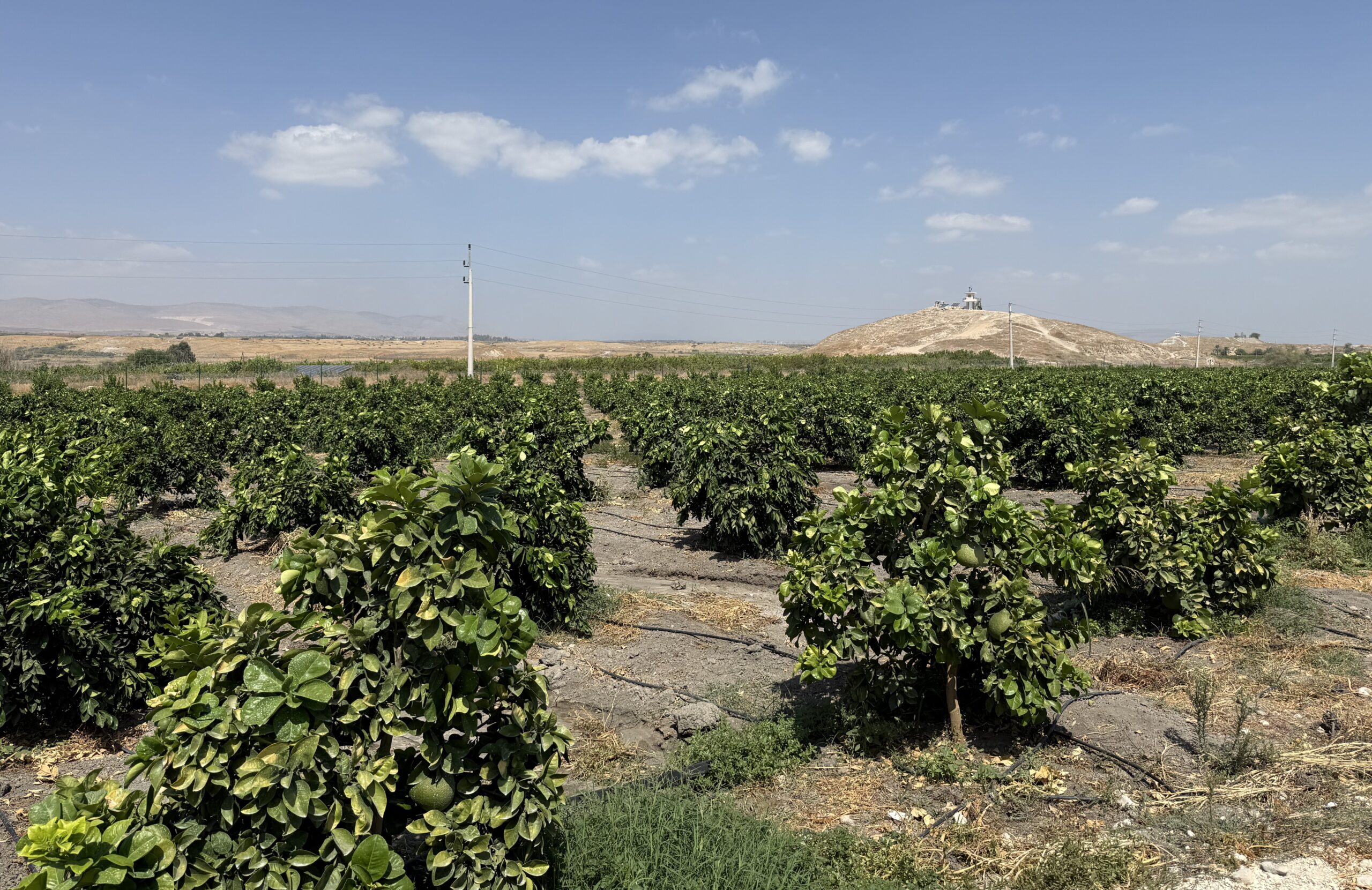
In September 2025, under the FAO/EBRD SEMED Food Security Package project, the FAO Investment Centre, in collaboration with the University of Jordan and the FAO Land and Water Division, launched a study titled Maximizing the Economic Productivity of Water in Jordan’s Citrus Sector at a national workshop in Amman, Jordan. The workshop brought together more than 60 participants from government agencies, research institutions, farmer organizations and private sector representatives to discuss the proposed methodology, policy options and data needs that will inform the study’s policy and investment recommendations.
We spoke with Dr Jawad Bakri, Professor in the Department of Land, Water and Environment at the University of Jordan and the University Coordinator supporting the study, about what water productivity means for farmers, policymakers and investors, and for the sustainability of such a scarce resource.
Q1. What’s the biggest misconception policymakers or investors have about water productivity on farms, especially in water scarce contexts?
Well, one of the biggest misconceptions is that higher yields automatically mean better water productivity. Whereas, chasing maximum output often comes at a cost, like groundwater depletion, soil salinization or pollution, for example. It’s not just about producing more, it’s about doing so sustainably.
Q2. How can we help shift thinking from “more water means more crop” to “smarter water use generates more profit and resilience”? What stories or examples have made this clear in practice?
We’re starting to see a shift at the policy level toward sustainable, tech-driven tools and farming practices, but on the ground, adoption is still quite uneven. At farm level, adoption largely depends on farmers’ exposure to technology, which varies widely.
At field level, some priorities would be rootstock, combinations of varieties (to expand harvest period and decrease market gluts), irrigation and fertilization calendars that favour quality and shelf-life, pruning and thinning to make production more even in terms of grades and more stable across years.
For smallholder farmers, it’s still more of a goal than a reality, because they’re often held back by limited extension services and training. What’s encouraging are the success stories from farmer field schools and targeted technology transfer initiatives. For example, when farmers can see side-by-side plots where using simple irrigation-scheduling apps or soil moisture monitoring reduces water use without hurting yields, the message becomes very real. These efforts, especially when you pair them with financial incentives like zero-interest loans, can really accelerate change.
Q3. Where do research findings and investor requirements most often miss each other in agricultural finance?
In my experience, the gap often comes from the fact that research and investment operate in very different worlds. Academic research tends to focus on technical indicators and long-term efficiency, while investors are looking for things like operational feasibility, risk and how decisions play out on the ground. When researchers haven’t spent much time involved in actual farm management, those practical concerns are sometimes missed or don’t come through very clearly.
For example, in Jordan, there is a structural issue that is also shaped by how the research system has evolved. A lot of work in agriculture is done by specialists trained in other fields, such as geology, for example, who bring strong analytical skills but not always hands-on farming or agribusiness experience. Going forward, narrowing this gap will require closer links between universities, farms and investors. This means more field-based research, more exposure to real production systems, and training that better connects technical analysis with commercial and operational realities.
Q4. Could banks and investors realistically use water productivity measures when assessing agricultural projects, or is something missing? What would make these metrics practical and trustworthy in the field?
Sure, they can, but only if the metrics are translated into something that banks can actually use. On their own, water productivity indicators like cubic metres per hectare or per kilogram of output are too technical for most investment decisions. Where they become useful is when they are linked to costs, risks and returns – the language of bankers.
For example, if water productivity data shows that a citrus farm using a specific irrigation setup consistently achieves the same yields but is using 20–30 percent less water than a comparable farm, this signals better performance and better-managed operation. And that kind of insight is far easier for banks and investors to factor into their decision-making.
What’s often missing is this translation layer. Consultants, extension services, or standardized tools can help bridge the farm to the banks, so water productivity figures point to risk and performance rather than just technical efficiency.
Consultants and extension services can work with farmers on farm performance and risk, and what may affect them, so that farmers themselves are prepared for a dialogue with the banks. Picking up on the above, a farmer who understands that the right rootstock and variety combination, together with appropriate practices (irrigation, fertilization, pruning, thinning, IPM) results in good quality fruit with a long shelf life and stable revenues and yields, and can demonstrate it to a Bank, makes a compelling case for financing, while also making the best use of resources. In the last workshop organized by the project, one such example was shown in the region. However, its set-up requires that most farmers adopt similar practices and that on-farm practices are followed up by good storage and transportation practices downstream.
Q5. If you fast forward five years, what actions or changes would mean real success in water productivity for farmers in Jordan? How will farms, communities and local markets look different if things go well?
This is a difficult question to answer, but looking ahead five years, real success in water productivity for farmers in Jordan might start with rethinking regulations, particularly those that govern land use. Aligning cultivated land with available water resources would be a big step toward sustainability.
But just as important is how crops move through the market. Today, many farmers are forced to sell immediately at harvest because they depend on one buyer or middleperson and have little access to storage. That pressure encourages them to maximize volume, even when prices are low and water is scarce. If farmers had more alternatives, like access to storage, clearer grading and more transparent selling channels, they could manage timing and quality instead of pushing output.
Also, some crops might need to be scaled back, especially the ones that consume a lot of water without delivering strong economic returns.
But policy alone won’t do it. Farmers, traders and consumers all need to be part of the change, and that includes how food is bought, sold and consumed. Today’s system pushes farmers to grow in bulk and sell everything at once, even when the market can’t absorb it. That leads to gluts, low prices, increased food loss and a lot of wasted water. The goal should be to move towards more responsive marketing and distribution, with better timing, better storage and better market signals. This would help farmers, improve markets and reduce pressure on increasingly scarce water resources.
***
Want to know more?
Check out this article on the launch of a new water irrigation study and this project page. Further information on WaPOR can be found here.