
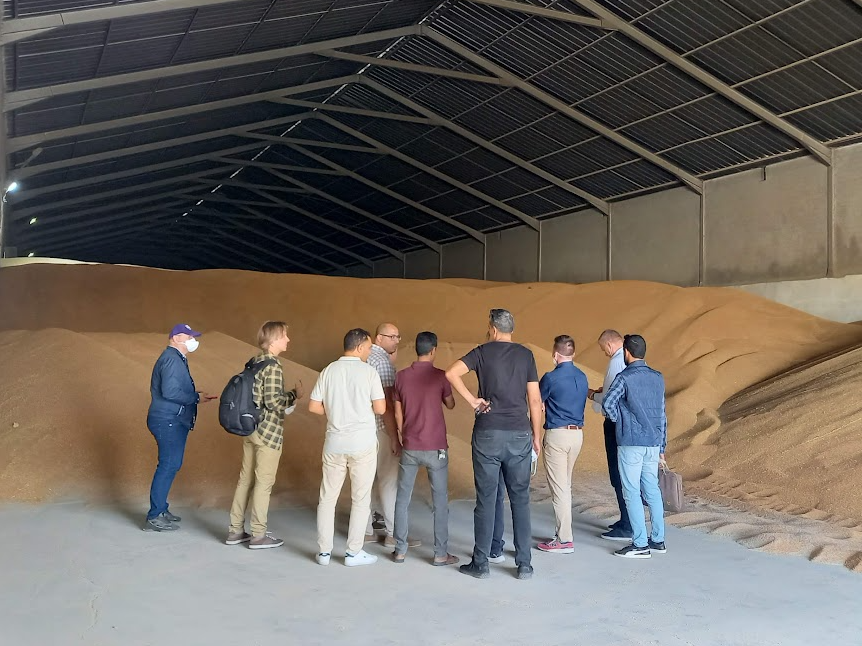
As global food systems face growing uncertainty, grain storage is becoming increasingly important across the Southern and Eastern Mediterranean (SEMED) region. With many countries relying heavily on imported grain, effective storage management is essential to reduce losses, preserve quality and strengthen food security, and Tunisia is no exception. Alongside public and private investment in grain storage infrastructure, strengthening the skills and technologies needed to manage the country’s grain stocks efficiently is key to building resilience against market and climate-related shocks.
To support this effort, the EBRD and FAO delivered a national training programme on 27–29 October 2026, in Tunis for the theory portion and in Sousse for the practical element, under the project “Grain sector reform to address structural weaknesses and increase private sector participation”, in the context of an EBRD sovereign-guaranteed loan to ODC in 2022.
Bringing together around 35 participants who were mainly technical staff from the Tunisian Cereals Office (Office des Céréales) responsible for managing domestic and imported grain stored in more than 20 silos across Tunisia, the training combined theoretical and practical components. Participants explored innovative approaches to storage management, monitoring of grain storage conditions, phytosanitary treatment and digital technologies designed to improve operational performance.
The effort to bolster food security in the country is built on a simple premise: ensuring a reliable grain supply depends not only on purchasing grain, but also on protecting it throughout transport and storage. Quality or quantity losses at any stage increase costs for the government, millers and consumers, and many of these losses can be prevented through better management practices and modern technologies. This principle underpinned the programme and helped to convey the importance of the training to the participants.
The training traced the grain’s journey from the exporting country to the silo, with participants learning about maritime fumigation and pest control during transit, best practices for silo management and monitoring of grain storage conditions, and the safe and effective use of fumigation within storage facilities. They also explored digital tools, including sensors and monitoring platforms, that help storage managers identify risks early and make decisions based on real-time data. Bringing these concepts to life, the experts showcased specialized equipment in the training room that sparked considerable interest among participants. The equipment included digital wireless sensors capable of monitoring grain quantity, temperature, moisture and CO2 levels, as well as an insect-monitoring probe that demonstrated its effectiveness during testing by collecting several pests. The training then moved from theory to practical at the Bouneb silo in Sousse, where participants observed a live small-scale fumigation trial that walked them through preparation, phosphine application, gas concentration monitoring and degassing.
By the end of the training, participants had gained practical insights into how digital solutions, monitoring technologies and improved operational practices can enhance storage performance and reduce losses.
The training is built on a successful model first implemented in Egypt in 2023, under the EBRD-FAO Food Security Package for the Southern and Eastern Mediterranean (SEMED) region, and has been adapted to address the specific priorities of other countries in the region. Earlier in October, a similar training was delivered in Jordan, under the same SEMED package. Jordan and Tunisia offer two important examples of countries investing in more efficient grain storage systems as part of broader food security strategies.
The training forms part of the broader FAO-EBRD partnership to promote more resilient agrifood systems. By supporting advances in grain storage and other key areas of food-system infrastructure, the partnership is helping countries reduce losses, optimize operations and build resilience against future shocks.
***
Read more about the training in this FAO Tunisia article, and find further details about the project supporting this work here.